An epoxy garage floor in Ottawa, built for February
Your garage floor has the hardest job of any floor you own. It carries a tonne and a half of car, takes a bath in salt water every winter evening, and is expected to look good anyway. A properly installed epoxy garage floor is how you win that fight.

At a glance
- Time on site
- One to three days for most garages
- Prep
- Diamond-ground wall to wall, cracks filled
- Finish
- Full flake under a clear, UV-stable topcoat
- Park on it
- Usually within a week, sooner with polyaspartic
- Best season
- Late spring to mid-autumn, or any time if heated
What an Ottawa winter does to a bare garage floor
Every winter evening the same thing happens in tens of thousands of Ottawa garages. A car pulls in with its wheel wells packed with grey slush. The door closes, the garage warms a few degrees above freezing, and over the next hour that slush melts into a puddle of salt brine that spreads across the slab and soaks in.
Concrete is porous. The brine goes into the top few millimetres and sits there. When the temperature drops again overnight, the water in those pores freezes and expands. When the car comes home the next day, it thaws. Salt makes this worse in two ways: it keeps the concrete wetter for longer, and it multiplies the number of times the surface crosses the freezing point. After enough cycles the top of the slab starts to come away in flakes and pits. The trade calls it scaling or spalling, and you will find it under the front tires of almost any twenty-year-old garage in the city.
The other half of the story is what does not wash out. Oil, coolant and washer fluid soak into bare concrete and stay there. The slab sheds a fine grey dust that travels into the house on shoes. And because raw concrete is dull and dark, the garage is always dimmer than its lights should make it.
An epoxy garage floor fixes these by doing one simple thing well: it closes the surface. Brine, oil and dirt stay on top of a hard, bonded layer of resin, where a squeegee or a mop removes them. The concrete underneath stays dry, and the freeze-thaw damage stops where it is.
What a proper garage floor system is made of
A garage floor coating is built in layers, and each layer has a job. If a quote leaves one of these out, ask why.
Day one is all grinding
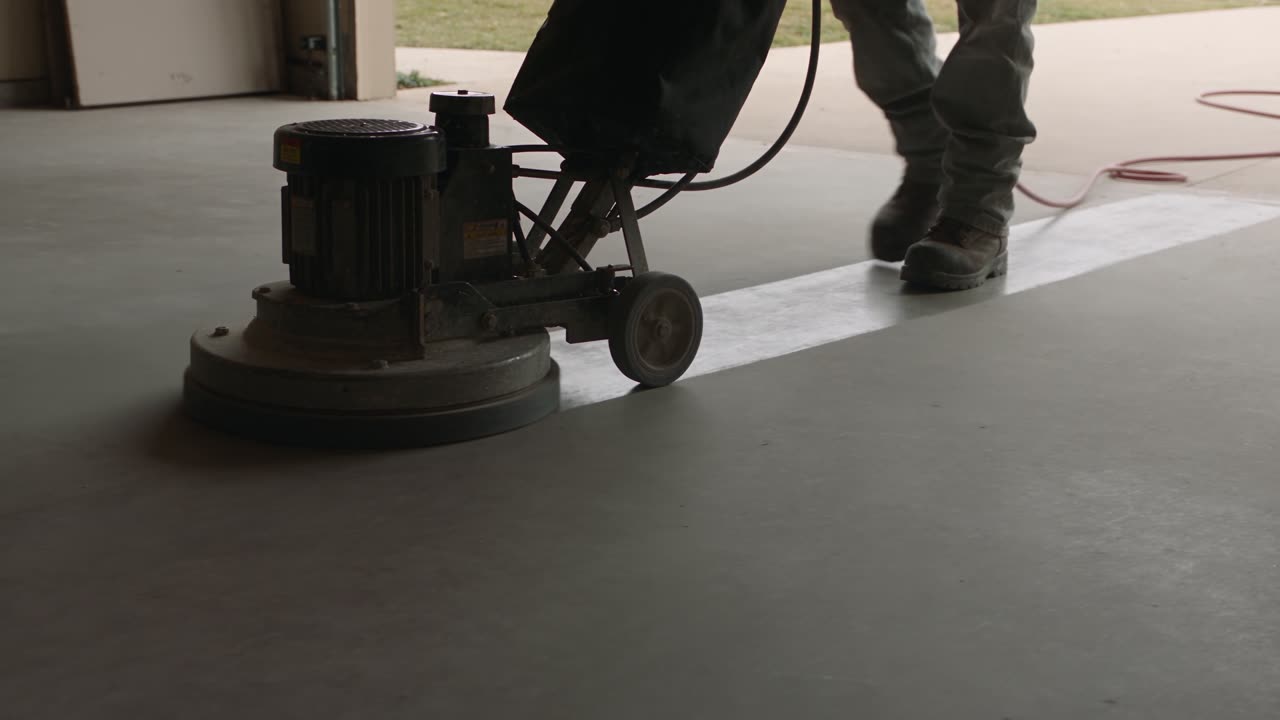
People are often surprised that the first visit involves no coating at all. A walk-behind planetary grinder with diamond tooling goes over every square foot of the slab, connected to a vacuum that takes the dust away as it is made. Hand grinders do the edges, the corners and the lip at the door.
On a newer home in Kanata, Barrhaven or Riverside South, the slab is usually hard, smooth and sealed by the builder, and the grind is about cutting through that closed surface. On an older garage in Orleans, Nepean or Alta Vista, it is about removing weak, salt-damaged concrete until sound material is reached.
Either way the result is the same: a clean, pale, slightly rough floor that will drink the first coat. If a coating is going to fail, it almost always fails here, so this is where the time goes.
Epoxy, polyaspartic or a kit from the hardware store?
Three things get sold as a garage floor coating. They are not close to being the same product.
| Professional epoxy system | Polyaspartic system | One-part kit or floor paint | |
|---|---|---|---|
| What it is | Two-part, high-solids epoxy base, flake, clear topcoat | Fast-curing two-part resin for some or all coats | Acrylic or latex paint with a little epoxy resin |
| Prep it needs | Diamond grinding | Diamond grinding | Usually an acid etch, done by the homeowner |
| Time on site | Two to three days | One to two days | A weekend |
| Park on it | About five to seven days | About one to two days | Often a week or more |
| Sunlight | Needs a UV-stable topcoat or it ambers | UV-stable by nature | Fades and chalks |
| Cold weather | Slab at about 10 degrees or warmer | Tolerates cooler slabs | Poor |
| Hot tires and salt | Resists both when bonded and cured | Resists both when bonded and cured | Commonly lifts under tires in the first year |
Typical characteristics. Exact figures depend on the product and are listed on its technical data sheet.
Hot-tire pickup, and why some garage floors peel
If you have seen a garage floor with four bald patches exactly where the car sits, you have seen hot-tire pickup. Tires come home hot from the highway. They soften a weak coating, grip it as they cool and contract, and pull it off the concrete the next time the car moves.
It is nearly always blamed on the tires, and it is nearly always a bond or cure problem. The coating was thin, or was a paint and not a true two-part resin, or was put on over an etched and still-sealed slab, or was parked on days before it had finished curing. A high-solids system, bonded into ground concrete and given its full cure time, is made to shrug this off.
This is also why the last instruction on any job matters as much as the first. A floor that feels hard after a day is not finished curing. Keep the car off it for as long as you are told to. The cure countdown on the main page gives typical dates.
Things worth deciding before the crew arrives
A garage floor is not complicated, but a few choices are easier to make now than later.
How much floor do you have?
A price starts with the area. Pick a typical garage or enter your own measurements, and send the numbers with your request.
Start from
Typical inside dimensions. Measure wall to wall at the floor, and mention steps, posts and drains.
How a garage job runs
From an empty garage to a parked car. Times are typical and depend on the system, the weather and how much repair the slab needs.
Empty the floor
Everything that sits on the slab comes out. Wall shelves, cabinets that hang and the garage door opener can stay.
Grind and repair
The slab is ground, vacuumed and inspected. Cracks and pits are filled and ground flush. This is most of the first day.
Base coat and flake
The base coat is rolled out and the flake is broadcast into it while it is wet, working backwards toward the door.
Scrape and seal
When the base has set, the flake is scraped and vacuumed and the clear topcoat goes on. With polyaspartic this can be the same day. With epoxy it is the next.
Cure
Foot traffic first, boxes and shelves next, the car last. You get the dates in writing.
When to book a garage floor in Ottawa
Resin cures by chemical reaction, and the reaction needs warmth. Standard epoxy wants the slab at about 10 degrees or warmer, and a slab is always colder than the air above it. In an unheated garage that makes the practical season roughly May to October.
September and October are the busiest weeks of the year, because that is when people look at the floor and think about the salt that is coming. If you want the floor done before winter, ask in summer.
A heated garage, or a polyaspartic system that tolerates cooler temperatures, can stretch the season at both ends. What cannot be worked around is a wet slab. A floor that is soaked with meltwater has to dry before anything goes on it.
Timing at a glance
- Best months
- May to early October in an unheated garage.
- Busiest
- September and October. Book ahead.
- Winter
- Possible in a heated garage, or with a cold-tolerant system on a dry slab.
- New builds
- Concrete needs about 28 days after the pour before coating.
- Before you list
- A coated garage photographs well. Allow a week before showings.
Typical guidance. The product data sheet sets the real limits for temperature and cure.
When can you park on it?
The floor feels hard long before it has finished curing. These are typical waiting times for the two common systems.
Cure countdown
When can I park on it?
Enter the day the topcoat went on, the system and how warm the slab is.
The system
The slab
- Walk on it in socks
- -
- Move things back
- -
- Park the car
- -
Typical times, not a guarantee. The data sheet for the product on your floor comes first.
What a coated garage is like to live with
The first thing most people notice is the light. A glossy floor in a mid or light blend bounces light back up, and the garage feels like a room for the first time. The second is the sound of a broom: dirt slides across the surface and does not grind into it.
In winter the routine changes a little. Meltwater no longer disappears into the slab, so it has to go somewhere. Most people push it out the door with a floor squeegee every few days, which takes a minute. A containment mat under the car does the same job if the floor slopes toward the house.
Salt dries to a white haze on any floor. On a coated one it wipes off with warm water and a mop. Use a pH-neutral cleaner when you want more than water, and skip vinegar, citrus cleaners and soap-based products, which dull the finish over time.
Treat the floor like the hard plastic it is. It will take dropped wrenches, rolling tool chests and a floor jack. It does not love a steel jack stand or a motorcycle kickstand on one small point, so put a square of plywood under those.
Questions people ask
How long does an epoxy garage floor take to install?
Most one and two-car garages take one to three days on site. A polyaspartic system can often be finished in a day or two. A standard epoxy system usually takes two to three, because each coat needs time to set before the next.
When can I park on the new floor?
With a standard epoxy system, plan on about five to seven days at room temperature, and longer if the garage is cool. Polyaspartic systems are often ready for a car in a day or two. You will be given dates for your product.
Will road salt damage an epoxy garage floor?
No. A cured resin floor is not attacked by road salt and does not absorb brine. The salt dries on the surface as a white haze and mops off with warm water.
Will it peel under hot tires?
A professional high-solids system that is bonded into diamond-ground concrete and fully cured is made to resist hot-tire pickup. Peeling under tires is typical of thin, one-part floor paints and of coatings applied over etched or sealed concrete.
Can you coat a garage floor that is cracked or pitted?
Yes, in most cases. Cracks are opened, filled with repair resin and ground flush, and salt-pitted areas are rebuilt before coating. Cracks that are still moving can show again over time, and you will be told if yours look like that.
Can an epoxy garage floor be installed in winter?
In a heated garage, yes. In an unheated one, standard epoxy needs the slab at about 10 degrees or warmer, so most installs happen between late spring and mid-autumn. Polyaspartic systems tolerate cooler slabs and can extend the season.
Is an epoxy garage floor slippery?
A smooth, glossy floor is slippery when wet. A full-flake floor has texture that helps a great deal, and a fine anti-slip additive can be added to the topcoat. Ask for it if the garage is your winter entrance.
Do I have to empty the whole garage?
Everything standing on the floor has to come out, because the whole slab is ground and coated. Shelving and cabinets fixed to the walls can stay.
How do I clean it?
Sweep or dust-mop, then mop with warm water and a little pH-neutral cleaner. In winter, squeegee meltwater out the door. Avoid vinegar, citrus and soap-based cleaners.
More from Epoxy Floors Ottawa
For the full picture, from surface preparation to cure times, and to watch a floor get coated as you scroll, see the main page for epoxy flooring in Ottawa, or go straight to a service.
Tell us about your garage
613-851-7831Call for the quickest answer, or send the form. You will get a call back with the options for your slab and a price.